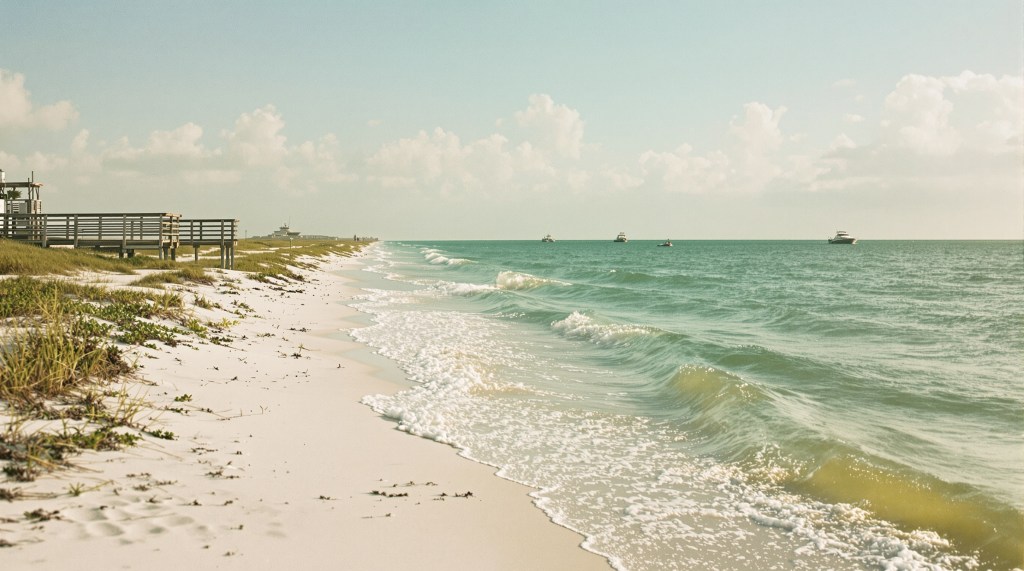
Guests ask the same question almost every trip: why is the water here green instead of that bright postcard blue? The answer is one of the best things about this island — and it’s the doorway into Estero Bay, a 10,000-acre wildlife nursery sitting right behind the beach.
Stand at the water’s edge on Fort Myers Beach and look straight out. No filter, no editing: the Gulf of Mexico here runs emerald, olive in the deeper cuts, and almost jade over the sandbars. It is not the electric turquoise of the Caribbean, and honestly, that is the whole point. That color is a working ecosystem — and it is the reason this stretch of coast has been feeding people for two thousand years.
Here is what you are actually looking at, and where to go see all of it.
Why the water turns emerald
Three things do it, and none of them are a filter:
- A shallow, sandy shelf. The Gulf seafloor off Estero Island drops away slowly. Light bounces off that pale bottom and comes back up, which is why color changes are so visible from a paddleboard.
- The estuary itself. Behind the island, Estero Bay pulls fresh, tannin-stained water off the land — the same tea color you get from mangrove leaves and cypress — and mixes it with Gulf saltwater. That mix tints the nearshore green and feeds everything in it.
- Seagrass. Thousands of acres of seagrass meadow lie under Estero Bay. Where the water is clear enough to see the bottom from a kayak, the green you are seeing is the grass, not the water.
Worth knowing: clarity moves with the weather. A windy north blow or a few inches of summer rain can turn the shallows milky for a day or two. That is normal here, and it is why local paddlers check the wind first and the tide second.
Estero Bay: Florida’s first aquatic preserve
In 1966, Florida designated Estero Bay the state’s first aquatic preserve — before Biscayne Bay, before anything else in the system. That designation is the reason the bay behind Fort Myers Beach still looks the way it did before the condos: no dredged channels cutting through the middle of the flats, no bulkheads along the mangroves, no high-speed traffic over the grass beds.
Today the bay and its surrounding uplands are protected as the Estero Bay Preserve State Park — roughly 10,000 acres of mangrove islands, seagrass flats, pine flatwoods and tidal creeks. It is one of the least-developed large estuaries left on Florida’s west coast, and it sits minutes from the island.
What is out there
This is not a nature documentary. These are things guests see on an ordinary Tuesday morning in the bay:
- Bottlenose dolphins. Resident, not passing through. They work the flats and channel edges, often within sight of the beach. Watch the birds — where gulls and terns dive on bait, dolphins are usually underneath.
- Manatees. Estero Bay is year-round habitat, but sightings get much more reliable as the water cools from November through March. They surface slowly and barely disturb the water — the giveaway is a swirl, or two nostrils breaking the surface, not a fin.
- Roseate spoonbills, great blue herons, snowy egrets, ospreys. The mangroves are a nursery for fish and a rookery for birds.
- Sea turtles. Loggerheads nest on the Gulf beaches roughly May through October. The Mound House runs turtle programming in season, and the nest stakes you see on the sand are the real thing — keep your distance and keep the lights off at night.
- Sport fish. Snook, redfish, trout, tarpon, jack. The reason charter captains here have such good days is that the nursery is right next door.
Five ways to see it
1. Lovers Key State Park — the best paddle in the area
South of the island over Big Carlos Pass, Lovers Key is about 1,600 acres of undeveloped barrier island with a marked kayak trail through the mangroves. Rent a kayak or paddleboard on site, or bring your own. There is a tram from the parking lot out to the beach, and the entry fee is a small per-vehicle charge — one of the best values on the coast. Go near high tide so you can get into the mangrove tunnels; at dead low tide some of the prettiest water is too skinny to paddle.
2. Matanzas Pass Preserve — the one most visitors never find
Tucked behind the Fort Myers Beach Public Library on the way off the island is a 60-acre maritime hammock with a boardwalk and nature trail that leads out to the back bay. Shade, silence, no beach traffic. It is a twenty-minute walk that resets your sense of the island — gumbo limbo, strangler figs, and the bay opening up at the end.
3. Bowditch Point Park — where the bay meets the Gulf
At the north tip of Estero Island, Bowditch Point is a small preserve where Estero Bay meets the Gulf front. The park has been under a restoration project, so check its status before you build a day around it — when it is open, it is the quietest beach access on the island.
4. The Mound House — two thousand years on the same shoreline
Fort Myers Beach’s Calusa history is literal: the Mound House sits on a shell mound built up over roughly two thousand years. The museum has an underground observation area where you can see the layers of shell for yourself, plus a dock out onto the bay. The Calusa did not farm — this estuary fed them, which makes it the original Fort Myers Beach attraction.
5. The science stops on Sanibel
Two Sanibel institutions are worth the short drive, especially with curious kids in the car: the Bailey-Matthews National Shell Museum & Aquarium, which explains the mollusks behind every shell on the beach, and CROW, the wildlife hospital that treats injured pelicans, owls and sea turtles from across southwest Florida. Both are family-friendly, and both make the beach make more sense.
The science is for guests, not just paddlers
You do not need a kayak to use any of this. A few easy habits make a beach day better:
- Look for the green water in the morning. The bay is typically calmest and clearest early, before the afternoon seabreeze kicks up.
- Walk the shell line after a front. Weather and tides rearrange the flats, which is why good shelling shows up in the days after a storm — not on a schedule.
- Bring polarized sunglasses. The single biggest upgrade to what you can see over the water — fish, rays, manatees, all of it.
- Pack water shoes. Mangrove roots and shell hash are sharp. They are the unsung hero of this island.
When to come for it
The bay is at its best in the shoulder seasons. October and November bring calm mornings, water still warm enough to swim, and birds moving through on fall migration. Winter keeps the bay flat and glassy and brings the manatees in close. Summer is the warm, green, lush version — afternoon storms, yes, but mornings on the water in June and July are as good as anywhere in Florida, and the light is spectacular.
Whichever season you pick, the pattern is the same: get out early, watch the wind, and let the birds tell you where the life is.
🏖️ Staying at "Do We" Beach House
The Gulf is roughly 600 steps from the front door — four bedrooms plus a den, 4.5 baths, sleeping 11, with a private heated pool, hot tub, ocean views and outdoor living spaces for the after-paddle unwinding. Bring the dog; the house is pet-friendly.
All bookings go through Coastal Vacation Properties. Check dates and availability on the Coastal Vacation Properties listing.
Come see the green water for yourself. It looks better in person — and it photographs just fine.
#fortmyers #comingbackstronger #FMBSTRONG #beachstyler #fortmyersstrong #fortmyersbeach #fortmyersflorida


Leave a comment